Types of Embroidery Patches: A Complete Guide to Styles, Backings, and Uses
Choosing the right embroidery patch involves more than simply selecting a design. In fact, the type of patch, stitching technique, backing material, and fabric all play an important role in determining how the finished patch looks, feels, and performs.
Whether you’re customizing a jacket, designing branded uniforms, creating team badges, or developing custom apparel, understanding the different types of embroidery patches can help you make the right choice. Additionally, knowing how each patch is made makes it easier to select an option that suits your design and intended use.
At Digitize4You, we understand that every embroidery design requires attention to detail. This is particularly important when creating embroidered patches because stitch direction, density, underlay, and design complexity all influence the final result.
In this guide, we’ll explore the most popular types of embroidery patches, their attachment methods, specialty designs, and the factors you should consider before choosing one.
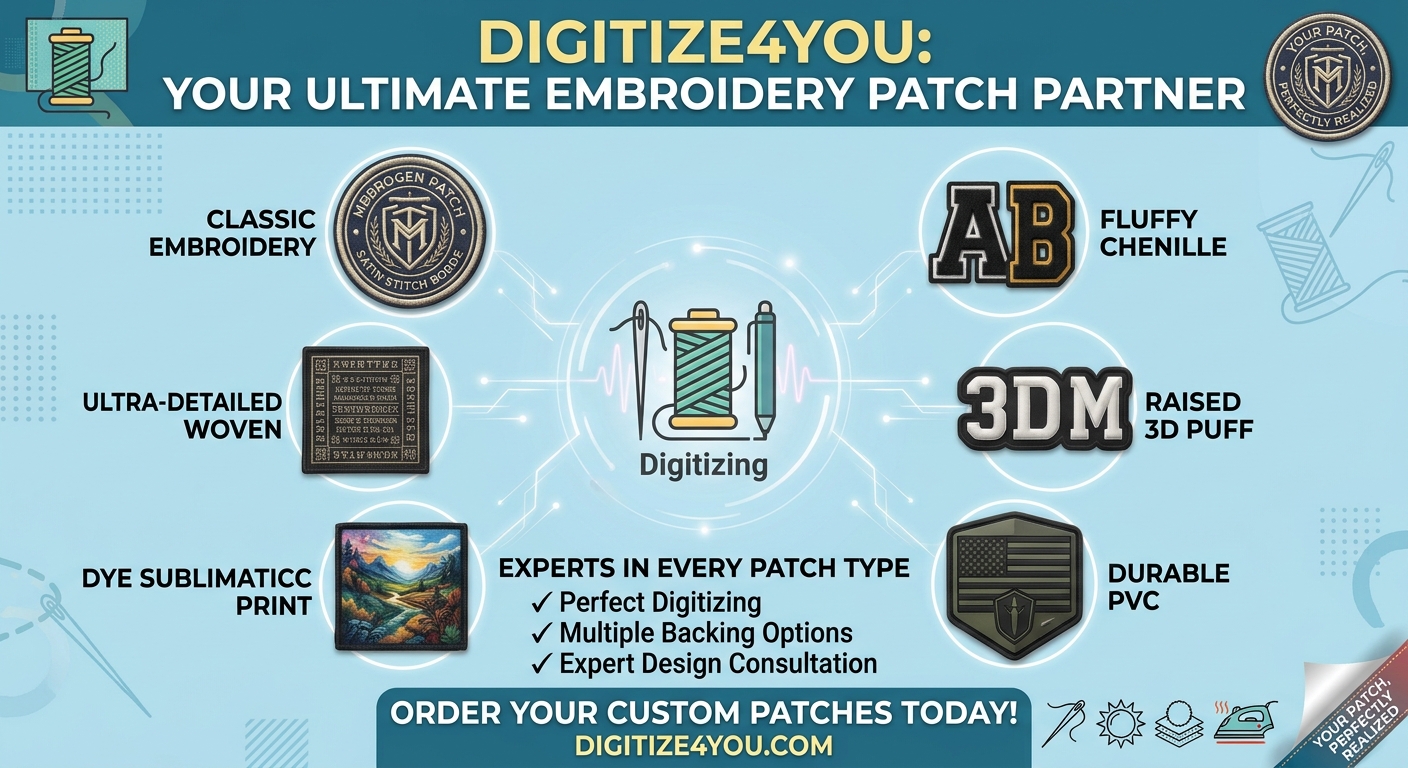
The 5 Main Types of Embroidery Patches
Not all patches are made using the same techniques. Some are designed for durability, while others focus on fine details, unique textures, or a premium appearance.
Therefore, understanding the differences between patch styles can help you find the right option for your project.
Let’s take a closer look at five of the most common types of custom patches.
1. Traditional Embroidered Patches
Traditional embroidered patches are among the most popular choices for clothing, uniforms, sports teams, and business branding.
Manufacturers create these patches by stitching embroidery threads onto a fabric base, usually twill or felt. As a result, the stitching creates a raised, textured appearance that gives logos and designs a distinctive embroidered finish.
Key Features:
- Raised and textured embroidery.
- Available in multiple thread colors.
- Suitable for logos, badges, and lettering.
- Commonly used on jackets, uniforms, caps, and bags.
- Can be finished with different borders and backing options.
However, the quality of an embroidered patch depends heavily on its embroidery digitizing file.
A poorly digitized design can result in thread bunching, uneven stitching, fabric puckering, and overlapping colors. On the other hand, professional embroidery digitizing helps ensure that the design is converted into an accurate stitch file that embroidery machines can follow.
Additionally, a properly prepared file takes the fabric, design dimensions, and stitching requirements into account. Consequently, it helps produce cleaner and more consistent embroidery results.
If you’re looking for professional-looking embroidered patches, proper digitizing is an essential first step.
2. Woven Patches
Manufacturers create woven patches by weaving fine threads together on specialized looms, rather than stitching embroidery threads onto a fabric base.
Because of this manufacturing process, woven patches can reproduce smaller details, thin lines, and fine lettering more clearly than traditional embroidered patches.
Key Features:
- Smooth and flat appearance.
- Excellent for small text and intricate details.
- Lightweight construction.
- Suitable for clothing labels and branding.
- Less raised texture than embroidered patches.
Woven patches are an excellent choice when a design contains details that may be difficult to reproduce using traditional embroidery. For example, clothing brands often use them for detailed labels and designs containing small lettering.
However, they don’t provide the raised, textured finish associated with traditional embroidered patches. Therefore, if texture and visible stitching are important to your design, embroidered patches may be a better option.
3. Printed Patches
Printed patches use techniques such as screen printing or dye sublimation to transfer artwork onto a fabric surface.
Unlike embroidered patches, printed patches have a flat finish. This makes them particularly useful for reproducing photographic images, complex gradients, and detailed artwork.
Key Features:
- Suitable for photographic designs.
- Supports complex color combinations.
- Smooth, flat surface.
- Useful for detailed artwork and illustrations.
- Does not provide the raised texture of embroidery.
Designers often choose printed patches when artwork contains gradients, shadows, or photographic elements that cannot be reproduced accurately with embroidery threads.
In contrast, traditional embroidered patches use thread to create their appearance. Therefore, they are generally better suited to designs where texture and stitching are important.
4. Chenille Patches
Chenille patches are recognized by their thick, soft, and fuzzy texture. They are commonly associated with varsity jackets, school sports teams, and letterman apparel.
These patches use looped or cut yarn attached to a backing material to create a distinctive raised appearance.
Key Features:
- Thick and soft texture.
- Bold and attractive appearance.
- Popular for varsity letters and team logos.
- Commonly used on jackets and sweatshirts.
- Best suited for larger designs.
Chenille patches are particularly popular for large lettering, numbers, and bold shapes. For example, schools and sports teams frequently use them for jacket initials and team emblems.
However, they are not generally suitable for designs containing extremely fine details. Instead, their strength lies in creating large, noticeable designs with a distinctive texture.
5. Bullion Patches
Bullion patches are premium decorative patches created using metallic threads or wires, often in gold and silver finishes.
They are commonly used for formal uniforms, ceremonial clothing, military-style insignia, and decorative crests.
Key Features:
- Metallic and luxurious appearance.
- Detailed decorative designs.
- Commonly used for formal insignia.
- Distinctive handcrafted finish.
Unlike standard machine-embroidered patches, bullion patches require specialized craftsmanship. Consequently, they are generally chosen for applications where a decorative and premium appearance is more important than mass production.
Different Types of Patch Backings and Attachment Methods
Selecting the right patch construction is only part of the process. You also need to consider how the patch will be attached to the garment.
Different backing options offer different levels of convenience, flexibility, and durability. Therefore, the best choice depends on the fabric, intended use, and expected lifespan of the patch.
1. Sew-On Patches
Sew-on patches are attached directly to garments using stitching around the patch edges.
They are one of the most reliable options for applications that require long-term attachment. Additionally, they can be used on a wide range of fabrics without relying on heat-activated adhesive.
Best For:
- Work uniforms.
- School clothing.
- Denim jackets.
- Sports apparel.
- Bags and backpacks.
Sew-on patches are particularly suitable for garments that experience frequent washing and everyday use. As a result, they are a popular choice for uniforms and clothing that needs a secure attachment.
2. Iron-On Patches
Iron-on patches feature a heat-activated adhesive on their back. When heat and pressure are applied, the adhesive activates and bonds the patch to suitable fabrics.
Because of this, You can apply iron-on patches relatively easily without sewing.
Best For:
- Cotton clothing.
- Denim jackets.
- Casual apparel.
- DIY clothing customization.
However, iron-on backing is not suitable for every fabric. Repeated washing, excessive heat, and improper application can also cause the adhesive to weaken.
For applications that require additional durability, sewing around the patch edges can provide extra security. Therefore, combining adhesive backing with stitching may be worth considering for frequently worn garments.
3. Velcro-Backed Patches
Velcro-backed patches use a hook-and-loop fastening system that allows patches to be attached and removed easily.
They are commonly used for uniforms, tactical equipment, bags, and outdoor apparel.
Best For:
- Tactical uniforms.
- Military-style clothing.
- Workwear.
- Backpacks.
- Removable identification badges.
Their biggest advantage is flexibility. Unlike permanently attached patches, Velcro-backed options can be replaced or changed whenever needed.
For example, organizations can use the same uniform while changing identification badges or role-specific patches.
4. Self-Adhesive Patches
Self-adhesive patches feature a peel-and-stick backing that allows them to be attached without heat or sewing.
They are mainly used for temporary applications, promotional displays, craft projects, and decorative purposes.
Although they are convenient, they generally do not provide the same long-term attachment as sew-on patches. Therefore, they may not be the best option for garments that experience frequent washing or heavy use.
Specialty Embroidery Patch Types You Should Know
In addition to traditional patch styles, several specialty techniques create unique appearances and textures.
These options are particularly useful for businesses, clothing brands, sports teams, and custom apparel designers. Furthermore, they allow designers to create distinctive products that stand out from standard patch styles.
1. 3D Puff Embroidery Patches
3D puff embroidery is a popular technique used to create raised lettering and designs.
The process involves placing embroidery foam underneath the stitching. The embroidery machine then stitches over the foam, creating a dimensional effect.
As a result, the finished design has a noticeable raised appearance that adds depth and texture.
3D puff embroidery is especially popular for caps, snapbacks, jackets, and streetwear branding.
Key Features:
- Raised, three-dimensional appearance.
- Excellent for bold lettering and logos.
- Creates a premium embroidered finish.
- Popular for caps and custom apparel.
However, 3D puff embroidery requires specialized digitizing techniques. Stitch density, underlay, column width, and stitch direction must all be carefully considered to achieve clean coverage.
For this reason, a standard embroidery file may not produce the desired result. Instead, the design needs to be prepared specifically for the puff technique.
At Digitize4You, we understand the importance of accurate embroidery digitizing when preparing designs for specialty embroidery applications.
2. PVC Rubber Patches
PVC patches are made from molded synthetic rubber rather than embroidery thread.
They have a flexible, rubber-like appearance and can feature raised layers, recessed details, and multiple colors.
Key Features:
- Water-resistant construction.
- Durable rubber-like finish.
- Suitable for outdoor equipment.
- Popular for tactical gear and backpacks.
PVC patches are particularly useful for products that require a distinctive appearance and resistance to outdoor conditions.
However, they are manufactured using specialized molding processes. Therefore, they are different from conventional machine-embroidered patches.
3. Laser-Cut Patches
Laser-cut patches are created by cutting materials such as felt, fabric, or leather into specific shapes using laser equipment.
This technique allows designers to create custom silhouettes and detailed outlines. Additionally, laser-cut materials can be combined with embroidery to produce distinctive designs.
For example, a patch can feature an embroidered logo with a custom-cut fabric border. As a result, the finished product can have a more customized appearance.
4. Glow-in-the-Dark Embroidery Patches
Glow-in-the-dark embroidery patches use specialized phosphorescent embroidery threads that absorb light and emit a visible glow in darker environments.
They are commonly used for decorative clothing, children’s apparel, novelty products, and selected visibility-related applications.
Unlike printed glow effects, these patches maintain the traditional stitched texture of embroidery. Consequently, they offer a unique combination of decorative appearance and embroidered detail.
5. Vintage and Hand-Embroidered Patches
Vintage and hand-embroidered patches are valued for their distinctive stitching styles and handcrafted appearance.
They are commonly used for retro clothing, collectible badges, denim jackets, and heritage-inspired fashion.
Traditional chain-stitch embroidery is one technique associated with vintage patch designs. In addition, handcrafted stitching can give each patch a slightly different appearance, making it suitable for designs that emphasize individuality.
How to Choose the Right Embroidery Patch for Your Project
With so many patch styles available, choosing the right one can feel overwhelming.
Fortunately, you can simplify the decision by considering the design, garment, intended use, and final appearance before making a choice.
Here are four important factors to consider.
1. Consider Your Fabric Type
The fabric receiving the patch plays an important role in determining the right attachment method.
For example:
- Cotton: Suitable for many sew-on and iron-on applications.
- Denim: Works well with traditional embroidered patches.
- Polyester: Requires careful consideration of heat and adhesive compatibility.
- Stretch fabrics: Sew-on attachment is often preferable.
- Heavy canvas: Suitable for durable embroidered patches.
However, not every fabric responds to heat or stitching in the same way. Therefore, always consider the garment manufacturer’s care instructions before applying heat or attaching a patch.
2. Think About Durability
Before selecting a patch, consider how frequently the garment will be washed or used.
For work uniforms, school clothing, and everyday apparel, sew-on embroidered patches are generally a reliable option. On the other hand, Velcro-backed patches offer more flexibility when identification badges need to be removed or replaced.
Similarly, self-adhesive patches may be sufficient for temporary decorative applications. However, they are usually not intended for the same level of everyday use as securely attached patches.
3. Match the Patch Style to Your Design
Different designs work better with different patch construction methods.
Here are some common examples:
- Detailed logos and small lettering: Consider woven patches.
- Traditional company logos: Choose embroidered patches.
- Large varsity letters: Consider chenille patches.
- Raised lettering: Choose 3D puff embroidery.
- Photographic artwork: Consider printed patches.
- Outdoor and tactical applications: PVC patches may be suitable.
Ultimately, matching the construction method to the artwork helps ensure that the final product looks closer to your original design.
4. Don’t Overlook Embroidery Digitizing Quality
If you’re choosing machine-embroidered patches, digitizing quality should be one of your main considerations.
Embroidery digitizing converts artwork into a machine-readable embroidery file containing instructions for stitching the design.
However, simply converting an image into a stitch file is not enough. A professional digitizing file must account for several technical factors, including:
- Stitch types and directions.
- Stitch density.
- Underlay settings.
- Pull compensation.
- Thread color sequence.
- Design dimensions.
- Fabric and backing requirements.
Without proper digitizing, even a professionally designed logo may not produce satisfactory embroidery results.
For example, excessive stitch density can make a patch stiff, while incorrect pull compensation can cause lettering and shapes to appear distorted. Similarly, unsuitable underlay settings may affect coverage and stability.
Therefore, working with an experienced embroidery digitizing service can make a significant difference to your final results.
Quick Guide: Which Patch Type Should You Choose?
If you’re still unsure which patch is right for your project, the following table provides a quick comparison.
| Project | Recommended Patch Type |
|---|---|
| Denim jackets | Embroidered or chenille |
| School uniforms | Embroidered sew-on |
| Company uniforms | Traditional embroidered |
| Sports team apparel | Embroidered or chenille |
| Tactical uniforms | Velcro-backed patches |
| Premium caps | 3D puff embroidery |
| Detailed clothing labels | Woven patches |
| Outdoor equipment | PVC patches |
| Promotional products | Printed patches |
| Vintage clothing | Hand-embroidered patches |
Keep in mind that these are general recommendations. The final choice also depends on your artwork, garment material, production requirements, and budget.
Why Professional Embroidery Digitizing Matters for Custom Patches
A great patch starts with a well-prepared design. However, artwork alone is not enough to achieve professional embroidery results.
Before a machine can stitch the design, the artwork must be converted into a suitable embroidery machine file. This process is known as embroidery digitizing.
Professional embroidery digitizing ensures that every stitch is placed according to the design’s requirements. Additionally, it helps account for the material, patch dimensions, and embroidery technique.
On the other hand, poor digitizing can lead to several production problems, including:
- Uneven stitching.
- Excessive thread breaks.
- Design distortion.
- Fabric puckering.
- Poor lettering quality.
- Incorrect stitch density.
- Unwanted gaps between colors.
These issues can affect both the appearance and production quality of a finished patch. Consequently, investing in proper digitizing can help reduce avoidable embroidery problems.
At Digitize4You, our focus is on providing quality embroidery digitizing solutions that help businesses, embroidery professionals, and apparel designers turn their artwork into machine-ready embroidery files.
Whether you’re preparing a company logo, custom patch, cap design, or detailed embroidery artwork, a properly digitized file is an important part of achieving a clean and professional result.
Need professional embroidery digitizing for your next patch project?
Visit Digitize4You and get your embroidery design digitized with attention to stitch quality, detail, and production requirements.
Final Thoughts
Choosing the right type of embroidery patch depends on your design, fabric, attachment method, and intended application.
Traditional embroidered patches remain a popular choice for uniforms, jackets, company branding, and custom apparel. Meanwhile, woven patches are better suited to fine details, while chenille and 3D puff embroidery offer distinctive raised textures.
However, selecting the right patch is only one part of achieving a professional result. For machine-embroidered patches, proper embroidery digitizing plays an equally important role.
Ultimately, a well-prepared design helps your embroidery machine reproduce the artwork with better stitch consistency and detail. Therefore, if you want your artwork to translate into clean, consistent embroidery, start with a professionally prepared digitizing file.
Choose Digitize4You for professional embroidery digitizing services and take your embroidery designs to the next level.
Frequently Asked Questions (FAQs)
1. What are the most common types of embroidery patches?
The most common patch styles include traditional embroidered patches, woven patches, printed patches, chenille patches, and bullion patches. Each type offers a different appearance, construction method, and application. Therefore, the best option depends on the design and intended use.
2. What is the difference between embroidered and woven patches?
Embroidered patches are created by stitching threads onto a fabric base, producing a raised and textured appearance. In contrast, woven patches are created by interlacing fine threads on a loom, resulting in a flatter surface that can reproduce smaller details.
3. Are iron-on patches better than sew-on patches?
Iron-on patches are convenient and relatively easy to apply. However, sew-on patches generally provide a more reliable long-term attachment. Ultimately, the best option depends on the garment material and how frequently the patch will be used or washed.
4. What is a 3D puff embroidery patch?
A 3D puff embroidery patch uses foam underneath the embroidery stitches to create a raised, three-dimensional appearance. This technique is especially popular for caps, snapbacks, and clothing logos. However, it requires specialized digitizing to achieve clean coverage.
5. Which embroidery patch type is the most durable?
Traditional embroidered patches with proper construction and sew-on attachment are a reliable option for garments that experience frequent use and washing. Similarly, PVC patches are a durable option for many outdoor applications.
6. Can any logo be converted into an embroidery patch?
Most logos can be adapted for embroidery, but some designs require modifications. For example, extremely small text, thin lines, gradients, and complex details may need simplification to achieve better stitching results.
7. What is embroidery patch digitizing?
8. Why should I choose professional embroidery digitizing services?
Embroidery patch digitizing is the process of converting artwork, logos, or designs into machine-readable embroidery files. During this process, stitch types, directions, densities, underlay, and other settings are selected to prepare the design for machine embroidery.
Professional embroidery digitizing helps improve stitch consistency, design accuracy, lettering quality, and overall embroidery appearance. Additionally, it helps reduce common production issues such as thread breaks, puckering, and poor stitch coverage.